Depth of Field Screen
Screenshots
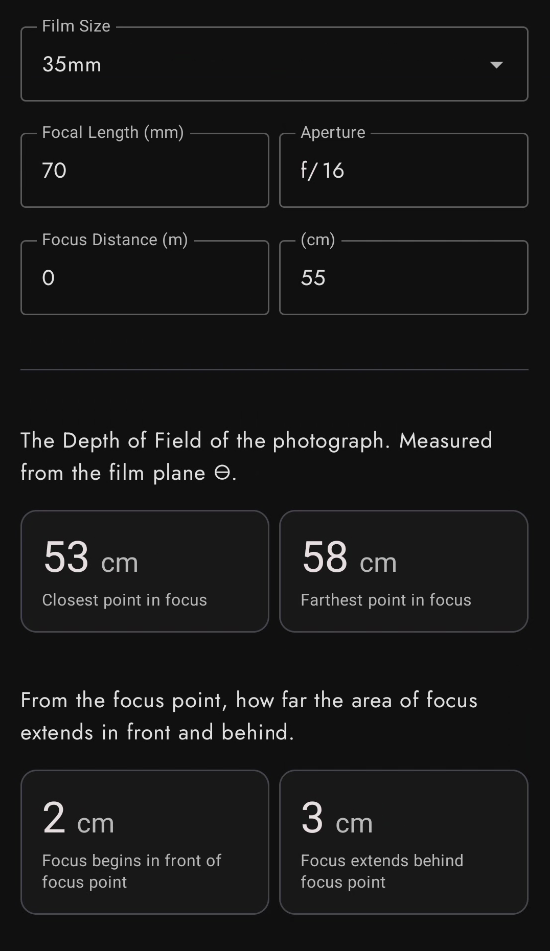
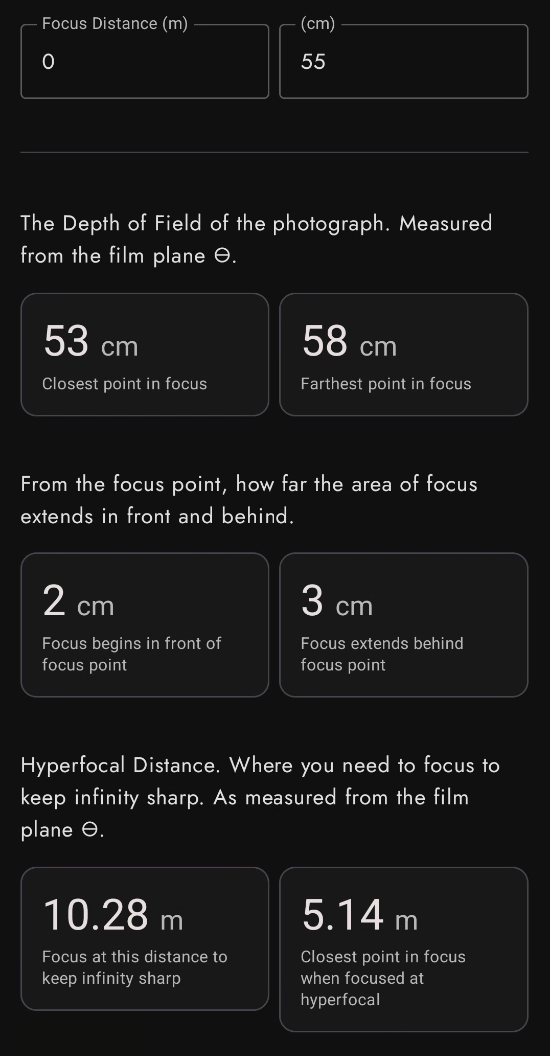
Description
1. Enter Camera and Lens settings
- Film size – This determines the circle of confusion used in calculations.
- Lens Settings – Focal length of lens (mm) and aperture (f-stop).
- Focus distance – The distance you have set the lens to focus at, measured from the film plane ⊖.
2. Read the Results
The calculator provides six key measurements:
Depth of Field Limits — The nearest and farthest points that will be acceptably sharp, measured from the film plane.
Depth in Front/Behind — How far the zone of acceptable sharpness extends in front of and behind your focus point.
Hyperfocal Distance — Focus at this distance to keep everything from half the hyperfocal distance to infinity acceptably sharp. Useful for maximizing depth of field in landscapes.
Hyperfocal Near Limit — When focused at the hyperfocal distance, this is the closest point that will be acceptably sharp.
–
Theory of Depth of Field
- Depth of field is the zone of acceptable sharpness in front of and behind the focus point.
- Smaller apertures (higher f-numbers like f/16, f/22) increase depth of field.
- Longer focal lengths decrease depth of field for a given aperture and focus distance.
- Closer focus distances decrease depth of field.
- “Acceptable sharpness” is defined by the circle of confusion, based on film format and standard viewing conditions.
Tips:
- For maximum depth of field in landscapes, focus at the hyperfocal distance rather than at infinity.
- For portraits, use the depth in front/behind values to understand how much of your subject will be sharp.
- Remember that depth of field extends approximately 1/3 in front of the focus point and 2/3 behind it (exact ratio varies with distance).
- All distances are measured from the film plane ⊖, marked on the camera body. Not measured from the front of the lens.
- At close focus distances, the far limit may exceed the hyperfocal distance, effectively reaching infinity.